The Collaborative Discipline Framework: Moving Beyond Rewards and Consequences
Traditional discipline often fails modern families. Learn how the collaborative discipline framework builds long-term cooperation and emotional intelligence.
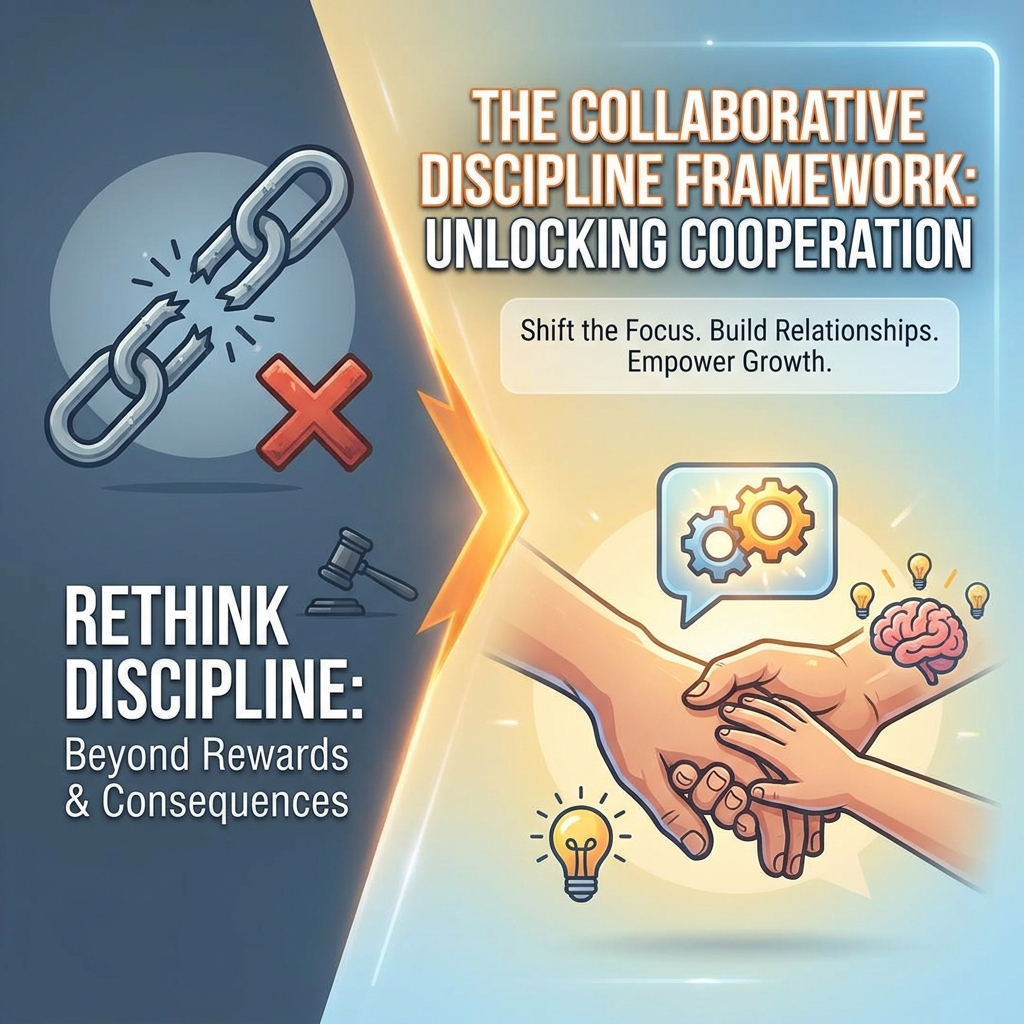
We have been conditioned to believe that parenting is a game of leverage. If they do the chore, they get the screen time; if they hit their sibling, they lose the toy. For decades, the carrot-and-stick approach was the gold standard. But as we navigate mid-2026, the data is becoming undeniable: traditional behavioral modification often secures short-term compliance at the cost of long-term character and connection.
When we rely solely on external pressures, we fail to address the internal state of the child. The result is often a cycle of escalating stakes where parents have to offer bigger rewards or harsher penalties to get the same basic level of cooperation. To break this cycle, we must transition to a collaborative discipline framework—a method that treats misbehavior as a lack of skills rather than a lack of will.
The Shift from Control to Coaching
Most parenting friction stems from a fundamental misunderstanding of what discipline actually means. Derived from the Latin discipulus, it means "to teach." It was never intended to mean "to punish." When a child struggles to follow a boundary, they aren't necessarily being defiant; they are often experiencing a gap in their ability to regulate their impulses or solve a specific problem.
This is why The Autonomy Gap: Why Modern Parenting Requires a Shift from Control to Coaching is such a vital concept for the modern home. Instead of acting as a judge who hands down sentences, the parent becomes a coach who helps the child navigate obstacles. This shift preserves the parent-child bond while building the very skills the child is currently missing.
Moving Beyond the "Naughty Chair"
Traditional time-outs or isolation tactics often trigger a child's threat response. When a child feels isolated during their moments of greatest emotional dysregulation, they learn that your love and presence are conditional on their "goodness." This is a primary reason why kids can feel unsafe even around loving parents. Collaborative discipline uses "time-ins" or regulated check-ins to ensure the child feels secure enough to actually learn from the mistake.
Building the Skill of Self-Regulation
Behavior is the tip of the iceberg; self-regulation is the massive structure beneath the surface. If a child cannot manage their frustration, no amount of lecturing will stop a mid-grocery-store meltdown. We must prioritize building the internal architecture that allows children to pause before they react.
Research shows that The Executive Function Gap: Why Academic Success Starts with Self-Regulation, Not Grades is the real predictor of future success. When we use collaborative discipline, we are directly exercising the prefrontal cortex. We ask questions like, "What was happening in your body right before you got angry?" or "What could we do differently next time?" These questions force the brain to move from the reactive amygdala to the rational thinking center.
The Role of Consistent Rituals
Regulation is easier when the environment is predictable. This is where The Micro-Routine Manifesto: How Anchor Habits Build Resilient Families becomes an essential tool. When children know what to expect, their nervous systems remain calm, significantly reducing the frequency of "disruptive" behaviors that require intervention in the first place.
Solving Problems, Not Managing Symptoms
In a collaborative framework, you treat the child as a partner in problem-solving. This isn't "permissive" parenting; the parent still sets the boundaries and non-negotiables. However, the child is given a seat at the table to discuss how those boundaries are met.
For example, if a toddler is constantly fighting against getting into the car seat, a control-based parent might use threats. A collaborative parent recognizes The Toddler Autonomy Shift: Transforming Power Struggles Into Cooperation and offers choices: "Do you want to climb in yourself, or do you want me to lift you like a rocket ship?"
How to Implement the Three-Step Solve
- Empathy Phase: Start by stating what you see without judgment. "I noticed it's been really hard to turn off the game when I ask."
- Define the Concern: State your boundary clearly. "The concern is that if we don't leave now, we'll be late, and I'll feel stressed."
- The Invitation: Ask the child for a solution. "Do you have any ideas on how we can make the transition easier tomorrow?"
This process respects the child's perspective while maintaining the parent’s leadership. It prevents the resentment that leads to deceptive behavior. We know that strict parenting often creates sneaky kids because children who fear punishment will prioritize hiding their mistakes over fixing them.
Creating an Environment of Radical Trust
Discipline cannot happen effectively without a foundation of trust. If a child feels they have to perform to be accepted, they will never be honest about their struggles. Conducting a regular emotional safety audit: how to build radical trust with your child helps ensure the "relational bank account" is full enough to handle the withdrawals of discipline.
When trust is high, children are more likely to admit when they’ve messed up. If they feel judged or shamed, the survival instinct kicks in. This explains why kids lie to protect themselves from parents; it’s often a physiological response to a perceived threat rather than a moral failing.
Practical Steps for Tomorrow Morning
Transitioning to a collaborative model doesn't happen overnight. It requires unlearning decades of cultural programming. Start with these three actions:
- Audit your language: Replace "because I said so" with "here is the reason for this boundary." Use the 6 phrases that shape a child's brain for life to reinforce their identity as a capable problem-solver.
- Delay the lecture: Never try to teach a lesson while the child (or you) is in a "red zone" of high emotion. Wait until everyone is regulated. Learning cannot happen during a fight-or-flight response.
- Involve them in the logistics: From chores to managing money, give them agency. Using a structure like The Financial Transparency Framework allows children to practice decision-making in a low-stakes environment.
Summary of the Collaborative Approach
Parenting is not about winning an argument. It is about raising an adult who can navigate complex emotions, solve interpersonal problems, and regulate their own behavior without a hovering authority figure. By moving away from a model of "doing to" our children and moving toward a model of "working with" them, we foster a home environment rooted in mutual respect rather than fear.
FAQ
Does collaborative discipline mean there are no consequences?
No. It means focusing on natural and logical consequences rather than arbitrary punishments. If a child breaks a toy, the consequence is that the toy is gone or they must help fix it. This teaches cause and effect rather than fear of the parent.
What if my child refuses to collaborate?
Collaboration is a skill that must be practiced. If a child refuses to engage, it's usually because they feel defensive or unheard. Revert to the empathy phase and focus on rebuilding the connection before attempting to solve the problem again.
Isn't this approach more time-consuming?
In the short term, yes. It takes longer to have a conversation than to take away a tablet. However, in the long term, it saves hundreds of hours by reducing the frequency of power struggles and building a child's internal motivation to do the right thing.