The Value-Based Frugality Blueprint: How to Cut Costs Without Cutting Joy
Learn how to master value-based frugality to eliminate wasteful spending while investing in what truly matters for your lifestyle and long-term wealth.
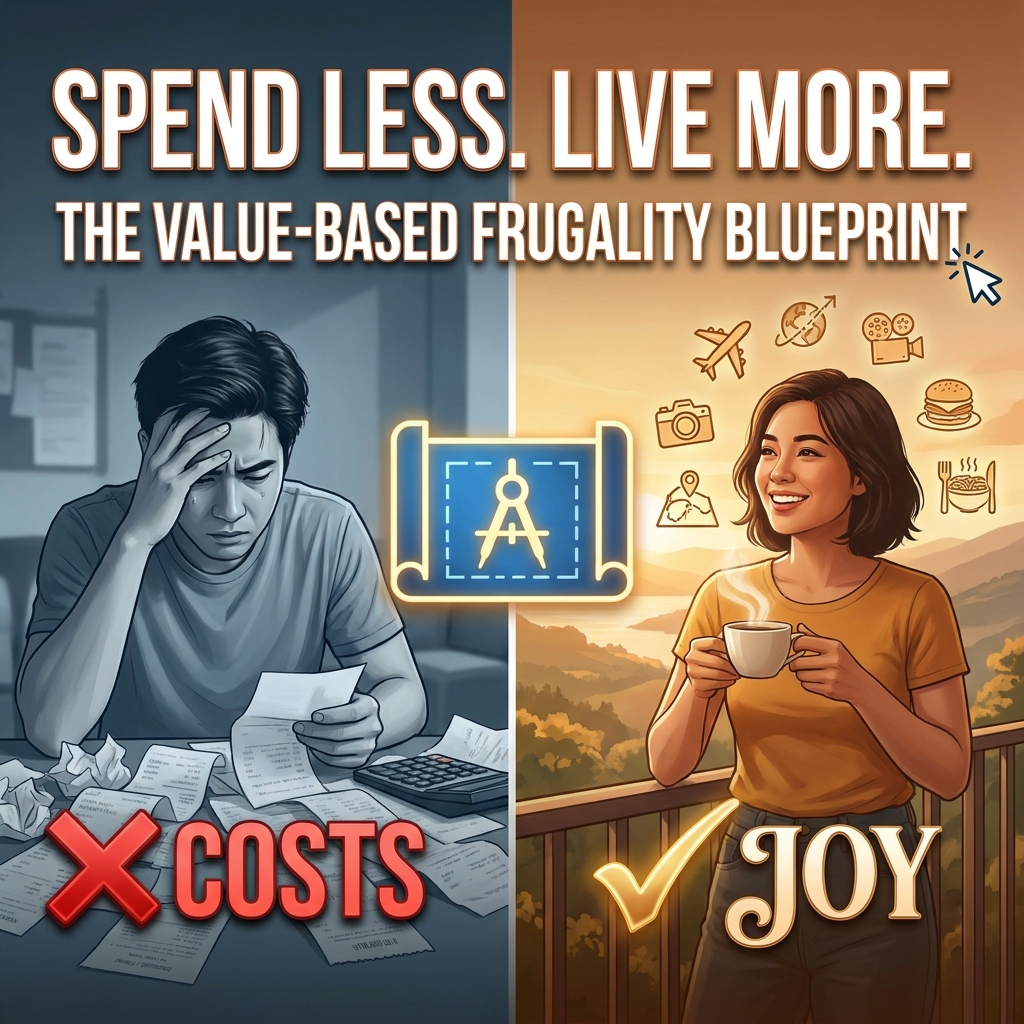
Frugality has a branding problem. For decades, the term conjured images of hoarding condiment packets, shivering in a cold house to save on utilities, and sacrificing every ounce of present-day joy for a distant, hypothetical retirement. In 2026, that version of frugality is not just unappealing—it is inefficient.
Modern frugality isn't about spending as little as possible. It is about maximizing the utility of every dollar you earn. We call this value-based frugality. It is a strategic approach that involves ruthlessly cutting costs on things that don't matter to you so you can aggressively fund the things that do. If you want to build wealth without feeling like you are living in a state of perpetual deprivation, you need a blueprint that prioritizes psychological satisfaction alongside your bank balance.
The Psychology of Selective Extravagance
The core of value-based frugality is the realization that you cannot have everything, but you can have anything that is truly important to you. Most people struggle with their finances because they spend "moderately" across all categories. They buy mid-tier clothes, eat at mid-tier restaurants, and drive mid-tier cars. The result? A massive drain on capital with zero peak experiences.
Selective extravagance flips this. You identify your "high-joy" categories—perhaps travel, high-quality food, or professional development—and you spend generously there. To fund this, you must apply the strategic frugality framework to your "low-joy" categories. If you don't care about cars, you drive a reliable ten-year-old sedan. If you don't care about fashion, you maintain a minimal, high-quality capsule wardrobe. By eliminating the middle ground, you create a surplus that feels like a raise.
Auditing the Invisible Leaks
Before you can redirect your capital, you have to find where it is leaking. Modern spending is designed to be frictionless, which makes it dangerous. Digital subscriptions, automated renewals, and "one-click" purchases bypass the logical centers of the brain.
To fix this, you don't necessarily need a restrictive budget that tracks every cent. Instead, consider zero-stress budgeting and cash flow mapping. This method focuses on directing your income into specific buckets before you have the chance to spend it impulsively.
Start by auditing your recurring digital expenses. In 2026, the average household pays for over 12 subscription services, many of which are rarely used. If you find your relationship with impulsive spending is truly broken, you might benefit from a no-spend reset to clear the slate and recalibrate your dopamine response to shopping.
Optimizing the Big Three: Housing, Transport, and Food
If you want to move the needle on your net worth, skipping a $6 latte won't do it. You have to optimize the "Big Three" expenses that typically consume 60-70% of a household budget.
1. Housing Optimization
It isn't just about the rent or mortgage. It’s about the total cost of the space. Modern frugalists are looking at "house hacking" or choosing locations that allow for a walkable lifestyle, which leads us to the second pillar.
2. Transportation Efficiency
Cars are wealth-killers. Between depreciation, insurance, fuel, and maintenance, the average car costs over $10,000 a year to own. By living in a transit-heavy area or utilizing e-bikes for short commutes, you can divert that $10,000 directly into high-yield savings rate optimization, turning a liability into a compounding asset.
3. The Food Strategy
Frugal eating in 2026 isn't about ramen. It’s about bulk-buying nutrient-dense whole foods and reducing food waste. Interestingly, this often aligns with better health outcomes, such as building resilient microbiomes through dietary diversity. When you view food as fuel rather than cheap entertainment, your grocery bill drops and your energy levels rise.
Turning Savings into a Wealth Engine
Frugality without an investment strategy is just hoarding. The goal of saving money is to buy back your time. As you begin to see a surplus in your accounts, you must move that money into assets that grow faster than inflation.
For those just starting, the fractional future of investing has made it easier than ever to enter the market with small amounts of capital. You don't need thousands of dollars to start; you just need a system. Once you have established a solid foundation, you can look toward more advanced structures, such as a multi-tiered high-yield savings strategy, to ensure your liquid cash is working as hard as possible while remaining accessible for emergencies.
The Longevity Link: Frugality for the 100-Year Life
Why does this matter so much now? Because the traditional retirement age is becoming an archaic concept. As life expectancy increases, our financial strategies must adapt. Frugality isn't just a phase; it is a tool for designing a retirement strategy for the 100-year life.
By keeping your overhead low and your investment rate high, you gain the "freedom to pivot." You aren't trapped in a high-stress job because you have to pay for a lifestyle you don't even enjoy. You have the margin to take risks, start a side venture, or take a sabbatical. This is the ultimate peak of value-based frugality: the ability to say 'no' to things that don't serve you because you've already said 'yes' to your financial future.
Actionable Steps to Start Today
- Identify Your Joy Categories: List three things you love spending money on. These are your protected zones.
- Slash the Remainder: Look at your last 30 days of transactions. Identify five expenses that provided zero lasting happiness and cancel or eliminate them.
- Automate the Surplus: Set up an automatic transfer for the amount you saved in step two. Direct it toward a high-yield account or a brokerage.
- Review Subscriptions: Use a tool or a manual scan to find every recurring charge. If you haven't used it in 30 days, kill it.
Frugality is not about scarcity; it is about intentionality. When you stop spending mindlessly, you start living purposefully. By adopting a value-based approach, you ensure that every dollar you spend is an investment in the life you actually want to lead.
Frequently Asked Questions
Does frugal living mean I have to stop eating out or traveling?
Not at all. Value-based frugality encourages you to spend on what you love. If travel is your passion, you might save money by living in a smaller apartment or not owning a car so that you can afford several high-quality trips per year. The goal is to eliminate spending on things you don't care about to fund the things you do.
How do I stay motivated when I feel like I'm missing out?
Focus on what you are gaining, not what you are giving up. Instead of thinking "I can't buy this," think "I am choosing to buy my freedom instead." Tracking your net worth or your "time to financial independence" can provide a much larger dopamine hit than a temporary purchase.
Is frugality still effective in a high-inflation environment?
Frugality is actually more important during inflation. When prices rise, the ability to distinguish between needs and wants becomes a superpower. By optimizing your big fixed costs (like housing and transport), you insulate yourself from the rising costs of smaller, variable expenses.