The Post-Career Pivot: Designing a Retirement Strategy for the 100-Year Life
Forget the 65-and-out myth. Learn how to build a dynamic retirement strategy that balances longevity risk, lifestyle design, and modern cash flow management.
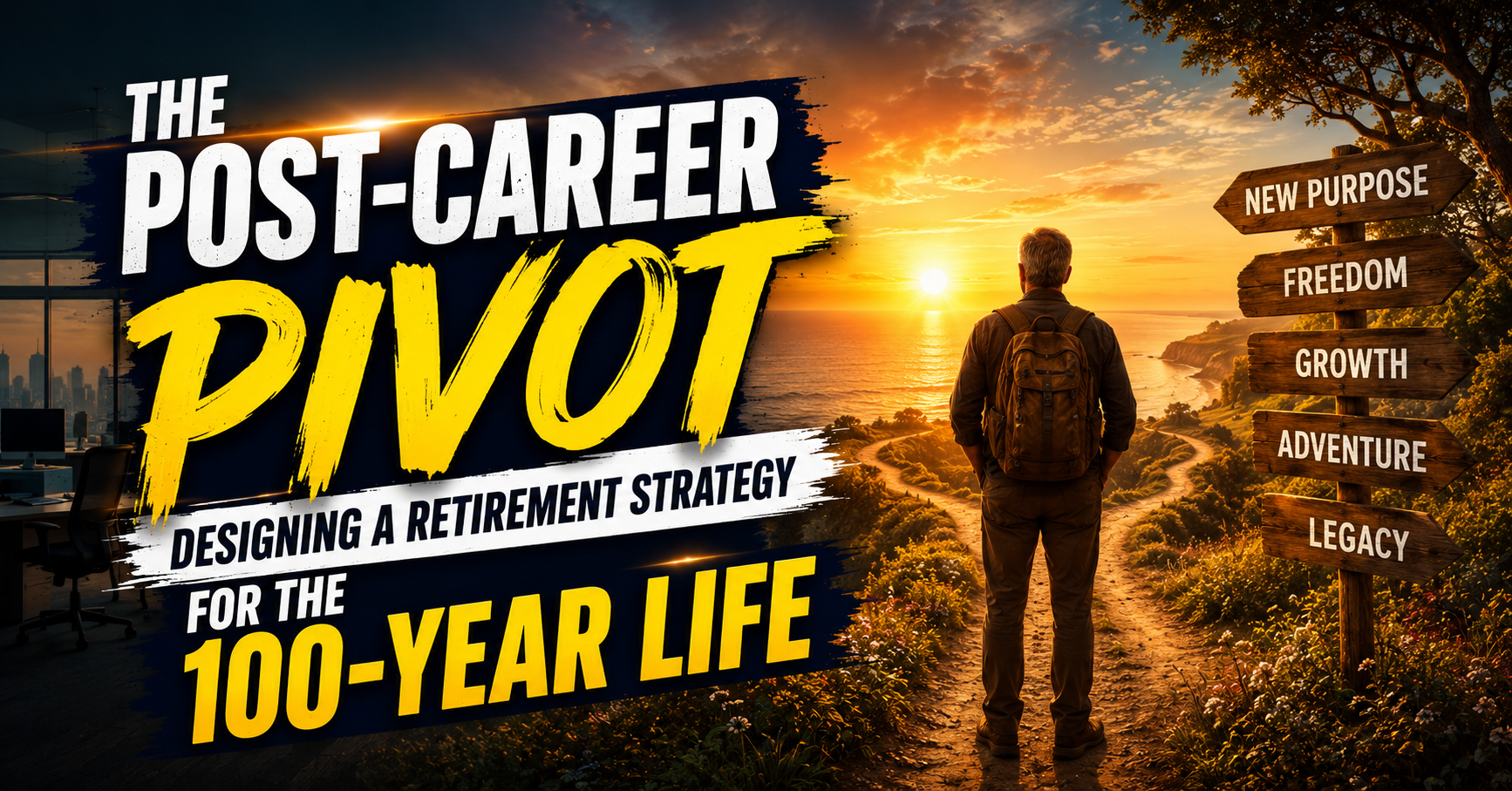
Traditional retirement planning is dead. The old model followed a predictable script: work for forty years, collect a gold watch, and live off a pension for fifteen more. But as we move further into the late 2020s, that linear path has been replaced by something far more complex and exciting. With medical advancements pushing life expectancy toward the century mark, the risk isn't just running out of money—it is failing to design a life that remains engaging and sustainable for four decades after you stop working full-time.
Modern retirement planning requires a shift from "saving for an end date" to "funding a permanent pivot." This article breaks down how to build a robust financial engine that supports longevity, manages modern volatility, and allows for the flexibility our ancestors never had.
Solving the Longevity Paradox
The greatest mathematical challenge in modern finance is longevity risk—the risk of outliving your assets. When planning for a 30 or 40-year retirement, the traditional 4% withdrawal rule often feels too rigid or too optimistic depending on market cycles.
Instead of a static withdrawal percentage, successful retirees are moving toward a floor-and-upside model. This involves securing your essential expenses (housing, food, healthcare) with guaranteed income streams like Social Security, annuities, or laddered bonds. Once the floor is covered, your remaining portfolio can be invested more aggressively to combat inflation.
If you are still in the accumulation phase, focusing on how to build an emergency fund fast is the first step in protecting your future self from high-interest debt that can erode your long-term compound interest. Security isn't just about the total number in your 401(k); it is about the reliability of the cash flow those assets produce.
The Three-Bucket Strategy for Volatility
Market volatility is inevitable, but "sequence of returns risk"—the danger of a market crash happening right as you start withdrawing—can be a retirement killer. To mitigate this, modern planners use a three-bucket system to manage liquidity.
- The Cash Bucket (Years 1-2): This contains two years of living expenses in high-yield savings or money market accounts. This ensures that if the stock market dips, you aren't forced to sell shares at a loss.
- The Income Bucket (Years 3-10): This holds less volatile assets like corporate bonds, REITs, and dividend-paying stocks.
- The Growth Bucket (Years 11+): This is where your aggressive equities live. Because you have a decade of cushion in the first two buckets, you can let these assets ride out any economic storm.
While building that first bucket, many people find that advanced high-yield savings tiered strategies offer the best balance of accessibility and growth. This prevents your "ready cash" from being eroded by inflation while keeping it safe from market swings.
Tax Diversification: Your Secret Weapon
Most people focus entirely on how much they save, ignoring the tax status of those savings. If 100% of your wealth is in a traditional 401(k), the IRS is your largest silent partner. Every dollar you withdraw will be taxed as ordinary income.
To maximize your future lifestyle, you need a mix of:
- Pre-Tax Accounts: (Traditional IRA/401k) for immediate tax breaks.
- After-Tax Accounts: (Roth IRA/401k) for tax-free growth and withdrawals.
- Taxable Brokerage Accounts: For flexibility and capital gains treatment.
By strategically withdrawing from these different accounts, you can control your reported income and potentially stay in a lower tax bracket during retirement. This level of control is similar to the precision required for zero-stress budgeting and cash flow mapping, where understanding where every dollar goes—and where it comes from—creates a sense of calm that a simple spreadsheet cannot provide.
Real Estate and the Flex-Economy
The modern retiree doesn't just hold stocks. Real estate remains a cornerstone of retirement planning, but the approach has changed. We are seeing a move toward "adaptive" properties—homes that can be partially rented out, used for multi-generational living, or easily liquidated.
Investing in property today isn't just about a primary residence; it’s about understanding how to build a modern property portfolio that generates passive income. This income can act as a "bridge" that allows you to delay taking Social Security, significantly increasing your monthly benefit later in life.
The Psychological Pivot
Financial readiness is only half the battle. Many retirees experience a "honeymoon phase" followed by a sharp decline in mental well-being because they lacked a plan for their time. Retirement planning should include a "lifestyle audit." Ask yourself: What will replace the social connection, purpose, and structure that work provided?
Setting a daily wellness routine for busy people now can help you transition into a structured retirement later. People who maintain their physical health and social circles find the transition significantly easier. This is also a time to focus on the health of your closest relationships. Just as you audit your finances, performing a micro-marriage habit audit ensures that you and your partner are actually on the same page about what your "golden years" look like. Spending 24/7 with a spouse after decades of separate work lives is a major adjustment that requires intentional communication.
Actionable Steps for the Next 12 Months
Regardless of your age, these steps will sharpen your retirement trajectory:
- Calculate your "Gap Number": Estimate your annual spending and subtract your guaranteed income (Social Security/Pensions). The difference is what your portfolio must cover.
- Optimize your Health HSA: If you have a high-deductible health plan, max out your HSA. It is the only triple-tax-advantaged account available and serves as a stealth retirement fund for medical expenses.
- Review Beneficiaries: Ensure your accounts are set to transfer smoothly. Financial peace of mind is as much about your legacy as it is about your lifestyle.
- Practice "Mini-Retirements": Use your vacation time to test-drive your retirement lifestyle. If you plan to move to a coastal town, live there for a month first to see if the reality matches the dream.
FAQ: Modern Retirement Planning
How much do I actually need to retire comfortably?
There is no one-size-fits-all number, but a common benchmark is 25 times your annual expenses. However, if you plan on a phased retirement (continuing to work part-time), that multiple can be significantly lower. Focus on your specific cash flow needs rather than a generic million-dollar goal.
Is the 4% rule still valid in 2026?
It is a helpful starting point, but most experts now suggest a "dynamic spending" approach. This means withdrawing more when the market is up and tightening the belt slightly when the market is down. This flexibility significantly reduces the risk of depleting your portfolio.
Should I pay off my mortgage before I retire?
Mathematically, it depends on your interest rate versus your expected investment return. Psychologically, however, entering retirement debt-free provides a level of freedom that is hard to quantify. If a low-interest mortgage allows you to keep more money in tax-advantaged growth accounts, it may be better to keep the loan. If the monthly payment causes stress, pay it off.