The Conflict De-Escalation Framework: How to Fight Fair and Stay Connected
Learn how to transform heated arguments into productive conversations with the Conflict De-Escalation Framework. Stop the cycle of blame and start connecting.
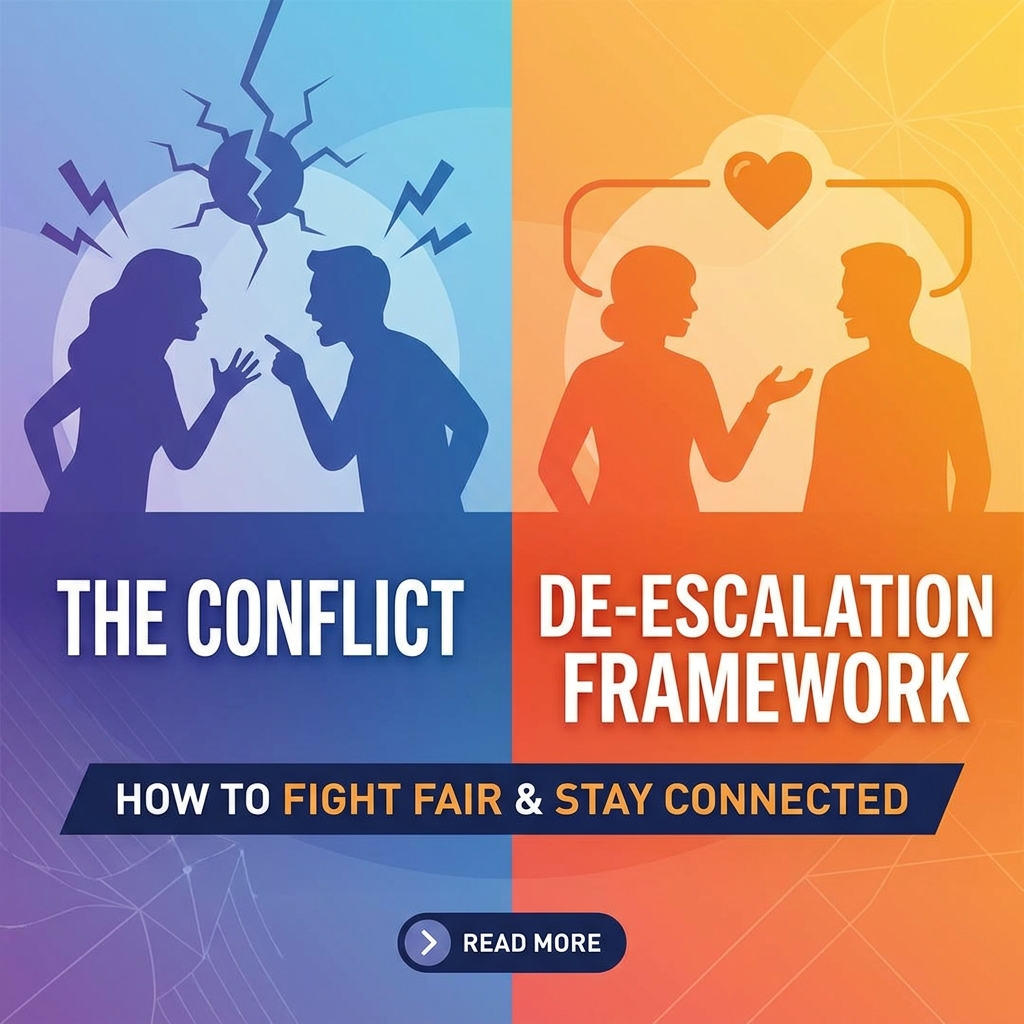
Every relationship experiences tension, but the difference between a partnership that thrives and one that erodes lies in how you navigate the heat of the moment. When a disagreement sparks, your brain often shifts into a primitive survival mode—fight, flight, or freeze. In this state, logic vanishes, empathy dissolves, and you end up saying things that leave lasting scars.
Modern conflict resolution isn't about avoiding arguments; it is about mastering the art of the "productive pivot." By implementing a structured framework for de-escalation, you can transform a potential breakup-level fight into a moment of profound understanding. Understanding your partner's internal state is the first step, much like recognizing the subtle signs she secretly likes you, which requires observation over reaction.
The Physiology of the Argument: Why Logic Fails
Before you can fix the way you fight, you have to understand why you fight poorly. When your partner criticizes you or brings up a sensitive topic, your amygdala—the brain's alarm system—triggers an emotional flood. This physiological response increases your heart rate and releases cortisol.
In this flooded state, you lose access to the prefrontal cortex, the part of the brain responsible for complex problem-solving and social nuance. This is why you might find yourself saying these to a woman makes you look desperate or reactive; you are literally not thinking with your whole brain. Recognizing this "flooding" is the first step in the de-escalation framework. If your heart is racing, the conversation is already over. You are no longer communicating; you are just reacting.
Step 1: The Tactical Pause and Internal Audit
The most powerful tool in conflict resolution is the ability to stop. When you feel the heat rising in your chest, you must call a "Tactical Pause." This is not the same as the silent treatment or stonewalling. It is a conscious decision to step away to regulate your nervous system.
During this pause, perform a small habit audit. Often, recurring fights are symptoms of neglected routines. As explored in the micro-marriage shift, small daily frictions can build up until they explode during a minor disagreement. Use the pause to ask yourself: "Am I actually mad about the dishes, or am I feeling undervalued?"
How to Call a Healthy Timeout
- Use a "We" Statement: "I’m starting to feel flooded and I want to hear you clearly. Can we take 20 minutes to cool down?"
- Set a Return Time: Never leave a conflict open-ended. Specify when you will come back to finish the talk.
- Self-Soothe: Do not spend the 20 minutes rehearsing your next comeback. Breathe, walk, or listen to music.
Step 2: Decoding the Language of Need
Once the physiological threat has passed, you need to translate the argument. Most conflicts are not about the "event" (the late text, the spent money, the forgotten chore) but about the "meaning" behind the event.
In 2026, our emotional expectations have become more complex. We aren't just looking for partners; we are looking for witnesses to our lives. This shift is part of why understanding modern emotional dialects is so vital. If she is upset that you didn't text, she might be feeling a lack of security rather than a need for status updates.
When you return to the conversation, replace "You" statements with "I" statements. Instead of saying, "You always ignore me," try, "I feel lonely when we spend the evening on our phones." This lowers the other person's defenses and invites them to solve a problem with you, rather than defend themselves against you.
Step 3: Validating Without Agreeing
One of the biggest hurdles in conflict resolution is the belief that validating your partner's feelings means you are admitting you were wrong. This is a fallacy. Validation is simply acknowledging their reality.
For example, if your partner expresses that they felt hurt by your distance, you don't have to agree that you were being cold. You can simply say, "I hear that you felt lonely when I was working late, and I can see why that would be frustrating for you." Sometimes, a partner might pull away as a defense mechanism; knowing when her distance is actually a test can help you navigate these moments with more empathy and less ego.
The Three Pillars of Validation
- Acknowledge: "I hear what you're saying."
- Reflect: "It sounds like you felt [emotion] because [event]."
- Empathize: "That sounds really difficult to deal with."
Step 4: The Collaborative Resolution
Once both parties feel heard, move toward the solution phase. This is where many couples fail because they try to solve the problem while they are still angry. Wait until the emotional charge is at a 2 or 3 out of 10.
Approach the problem as a team. It’s not You vs. Her; it’s You + Her vs. The Problem. If the issue is about communication frequency, don't just promise to "do better." Set a specific, actionable goal. Perhaps it's a habit stacking reboot where you commit to a 5-minute check-in every morning before work. Specificity kills resentment.
Handling the Aftermath: Repair Attempts
Successful couples are not those who don't fight, but those who are good at "repair." A repair attempt is any statement or action—silly or serious—that prevents negativity from spiraling out of control. It could be a self-deprecating joke, a touch on the shoulder, or a simple "I'm sorry I snapped."
If you've had a particularly rough patch, you might need an intentional dating reset to rediscover the connection that exists outside of your conflicts. Conflict creates a temporary wall; repair is the process of tearing it down brick by brick.
Summary of the Framework
- Recognize the Flood: Identify when your body is in fight-or-flight.
- The Tactical Pause: Step away for 20-30 minutes to regulate.
- Identify the Underlying Need: Move past the surface-level argument to the emotional core.
- Validate the Experience: Acknowledge their perspective without needing to be "right."
- Co-Create a Solution: Set specific, actionable changes to prevent recurrence.
By following this structure, you move away from the destructive cycles that lead to broken hearts and toward a relationship built on psychological safety. Conflict is not a sign of failure; it is an invitation to grow deeper in your understanding of one another.
FAQ: Mastering Modern Conflict
What if my partner refuses to take a pause and follows me into the other room?
Set the boundary clearly before a fight happens. Explain that you need the pause to be a better partner, not to escape. If they follow you, calmly repeat: "I am taking 20 minutes to calm down so I don't say something I regret. I will be back at [Time]." Consistency in returning at the promised time builds the trust necessary for them to let you walk away.
How do I know if a conflict is "unsolvable" or just difficult?
Research by the Gottman Institute suggests that 69% of relationship problems are perpetual—meaning they never fully go away because they are based on personality differences. The goal isn't to solve them, but to manage them with humor and dialogue rather than gridlock and contempt. If you can talk about the issue without attacking each other's character, it is manageable.
Why do I always feel like I'm the one initiating the de-escalation?
It can feel unfair, but someone has to be the first to lower their shield. Think of it as leadership within the relationship. Often, when one partner consistently models healthy de-escalation, the other partner eventually feels safe enough to lower their own guard. If you lead with empathy, you change the entire ecosystem of the partnership.